Span and lifting height are two major factors that influence RTG crane price because they directly affect the crane’s structural dimensions, steelwork, lifting mechanism, stability requirements, and overall configuration. A wider span generally requires a larger and stronger gantry structure, while greater lifting height requires longer legs, higher lifting travel, and a hoisting system capable of handling the required vertical movement. However, price does not increase at a fixed rate per meter. The actual impact depends on rated capacity, container arrangement, duty cycle, wheel configuration, power system, operating conditions, and other project requirements. For buyers comparing RTG crane prices, span and lifting height should therefore be evaluated together with the complete crane configuration rather than as isolated dimensions.
What Do Span and Lifting Height Mean on an RTG Crane?
Before comparing RTG crane prices, it is important to distinguish the two dimensions.
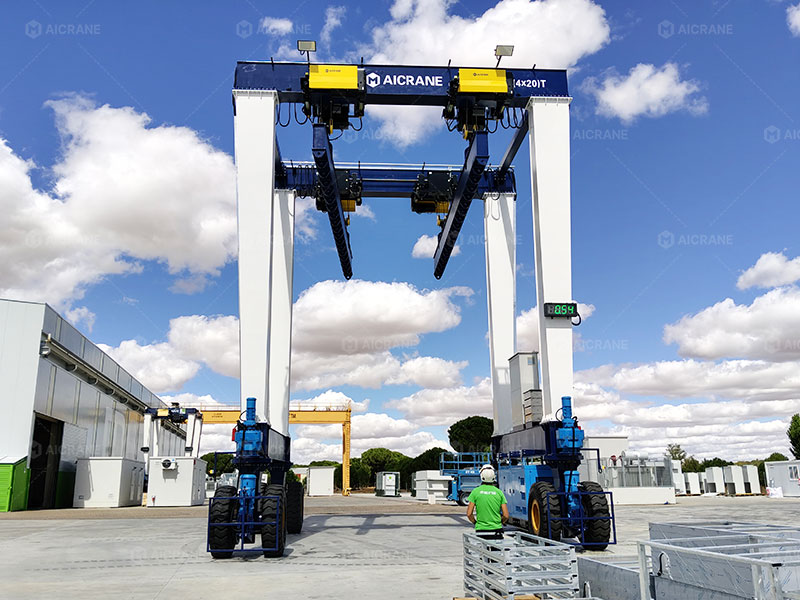
Span is the horizontal distance between the crane’s supporting legs. On a rubber tyred gantry crane, the span determines the working width underneath the gantry and therefore how many container rows or lanes the crane can cover.
For example, an RTG used in a container yard may be designed to span several container rows plus a truck lane. A larger span provides wider coverage but requires the gantry structure to bridge a greater distance.
Lifting height refers to the vertical height through which the hoisting system can raise the load. For container-handling RTGs, this is closely related to the number of containers that can be stacked vertically. The required lifting height may therefore be specified according to a stacking configuration such as 4-high or 5-high, although the exact terminology and dimensions vary by crane design.
These dimensions should be defined according to the actual yard layout rather than selected independently.
How Does Span Affect RTG Crane Price?
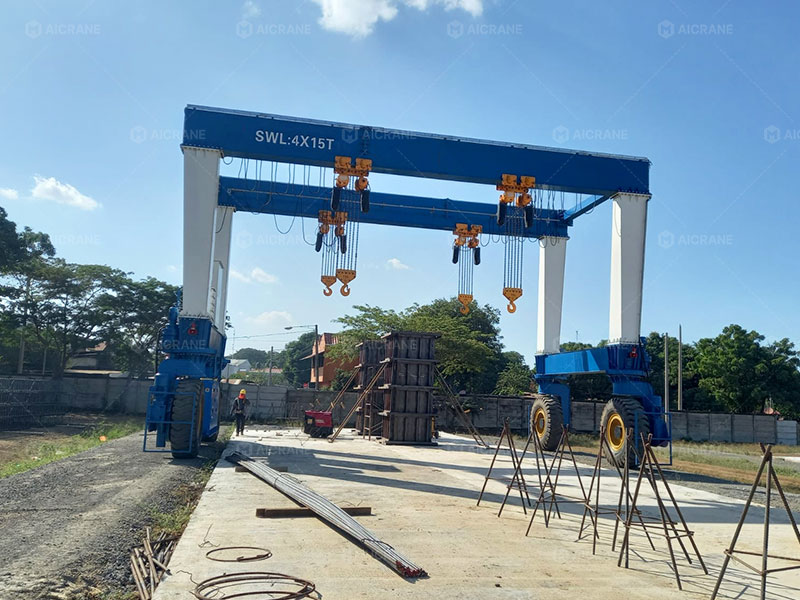
A larger RTG span usually increases the amount and complexity of structural steel required.
Wider span means a larger gantry structure
The main gantry must withstand the load while maintaining adequate stiffness and stability across the required width. As span increases, structural design becomes more demanding.
A wider mobile gantry crane may require:
- Larger or differently configured main beams
- Increased structural steel quantity
- Reinforced connections and supporting members
- Greater attention to deflection and stability
- Changes to leg geometry and overall crane dimensions
The relationship is not simply “10% more span equals 10% higher price.” Structural requirements depend on the rated load, wheelbase, trolley arrangement, lifting height, and applicable design standards.
For this reason, two RTGs with the same rated capacity but different spans can have noticeably different prices.
Span also affects operating coverage
The commercial reason for selecting a larger span is usually increased yard coverage. A crane that can serve more container rows may reduce the number of crane travel positions required for a particular yard layout.
However, a wider span is not automatically economically preferable. If the available container block or truck lane does not require the additional width, paying for a larger structure may increase equipment cost without providing equivalent operational value.
Practical purchasing rule: specify the minimum span that safely and effectively covers the required operating area, including container rows, truck lanes, clearances, and access requirements.
How Does Lifting Height Affect RTG Crane Price?
Lifting height influences both the crane’s structural dimensions and its hoisting system.
Higher lifting height requires taller structures
Increasing the lifting height generally means that the RTG needs taller legs and greater overall clearance. The structural design must maintain adequate stability while supporting the trolley and suspended load at the required elevation.
The resulting price impact can include:
- Additional structural material
- Taller supporting legs
- Increased design requirements for stability
- Longer hoisting travel
- Changes to cable or energy-management arrangements
- Additional clearance requirements within the yard
The exact increase depends on the gantry crane capacity and configuration.
Lifting height is closely related to stacking requirements
For container yards, lifting height is normally determined by the required stacking arrangement rather than by an arbitrary preference for a taller crane.
For example, a yard designed around higher container stacks may require a greater lifting height than a lower-density storage area. The RTG must also provide sufficient clearance for the spreader and container handling operation at the highest required position.
Therefore, buyers should provide the intended stacking height or container-row configuration when requesting an RTG crane quotation.
Does a Larger Span or Higher Lift Always Mean a Higher Price?
Generally, increasing either dimension tends to increase the engineering and manufacturing requirements, but the price relationship is not linear or universal.
For example, consider two hypothetical RTG configurations:
- RTG A: moderate span and lower stacking height
- RTG B: wider span and higher lifting height
Even if both cranes have the same rated capacity, RTG B may require a larger structural frame and a more extensive lifting arrangement.
But if RTG A and RTG B also use different power systems, control technologies, spreaders, travel mechanisms, or automation functions, those factors can have a substantial effect on the final quotation.
This is why an RTG crane price should be compared using a complete technical specification rather than only the span and lifting height.
Which RTG Crane Specifications Should Be Evaluated With Span and Height?
Rated lifting capacity
Capacity is one of the fundamental price drivers. A crane designed for heavier loads generally requires stronger structural and mechanical components.
For container applications, the required lifting capacity should account for the spreader and the maximum container-handling configuration specified for the project.
Number of container rows
The number of rows the RTG must cover is directly related to span. Buyers should provide the actual yard arrangement rather than simply asking for a “large span.”
The layout should identify:
- Container rows
- Truck lanes
- Required clearances
- Crane travel paths
- Existing infrastructure
- Adjacent equipment
This allows the manufacturer to determine an appropriate span.
Stacking height
Instead of specifying lifting height only in meters, container-yard buyers should also describe the intended stacking configuration. This gives the crane designer operational context for determining the required hoisting travel and clearance.
Duty cycle
An RTG operating continuously in a high-throughput container terminal has different design requirements from one operating intermittently in a smaller yard.
Duty classification can influence mechanical component selection, motor sizing, braking systems, structural design, and maintenance requirements.
Power and energy system
RTGs may use different power arrangements, including diesel-generator systems, cable reels, or battery-based configurations depending on the project.
The power system can significantly affect total equipment cost and should be included when comparing quotations.
Automation and control functions
Manual, remote-controlled, semi-automated, and automated RTGs can have substantially different system requirements.
Automation may involve positioning systems, anti-sway functions, container identification, remote operation, safety systems, and yard-management integration. These should be separated from the structural price impact of span and lifting height.
How Should Buyers Compare RTG Crane Prices?
A useful comparison starts with a standardized technical specification.
For each quotation, record at least:
- Rated lifting capacity
- RTG span
- Lifting height
- Number of container rows served
- Number of stacking tiers
- Working class or duty requirements
- Spreader configuration
- Travel speed and hoisting speed
- Power supply or energy system
- Control and automation functions
- Operating environment
- Delivery and commissioning scope
This prevents a common purchasing problem: comparing two prices that appear different but actually represent different crane configurations.
For example, a quotation with a lower RTG crane price may have a smaller span, lower lifting height, simpler spreader, or different power arrangement. The lower price therefore does not necessarily represent the same equipment scope.
How Can Span and Lifting Height Be Optimized to Control Cost?
The objective should not be to minimize span or lifting height. Instead, the goal is to avoid paying for capacity or coverage that the yard does not need.
Optimize span around the actual yard layout
Determine the required number of container rows and traffic lanes first. Then establish the minimum practical span that provides the necessary coverage and operating clearances.
Optimize lifting height around stacking requirements
Determine the maximum intended stacking level and required container clearance. Avoid specifying excessive lifting height simply to create additional flexibility that will rarely be used.
Consider future expansion separately
If the yard is expected to increase its storage density, future requirements should be included in the planning discussion. Increasing lifting height or span later may be more complicated than specifying an appropriate configuration initially.
However, the additional initial investment should be compared against the expected operational requirement rather than automatically maximizing the crane dimensions.
What Other Factors Can Change RTG Crane Price?
Span and lifting height are important, but they are only part of the pricing equation.
Other major factors include:
- Rated capacity: Heavier lifting requirements increase structural and mechanical requirements.
- Crane configuration: Single- or double-girder arrangements and different trolley designs affect engineering and material requirements.
- Power system: Diesel-generator, cable reel, and battery-based solutions have different equipment and infrastructure requirements.
- Spreader: Fixed, telescopic, twin-lift, and other configurations can have different costs.
- Control system: Automation, remote operation, anti-sway, positioning, and safety systems add equipment and integration requirements.
- Operating environment: Wind, temperature, corrosive conditions, and site elevation can influence component selection and design.
- Travel requirements: Ground conditions, travel distance, wheel loads, and yard layout affect the travel system.
- Standards and certification: Required design codes, testing, inspection, and certification can affect engineering and project costs.
- Delivery scope: Transportation, installation, commissioning, operator training, and spare parts may or may not be included in the quoted price.
These factors explain why an RTG crane price should normally be requested from a complete project specification.
A Practical Example: Why Two Similar RTGs Can Have Different Prices
Suppose a buyer is evaluating two RTGs for container handling. Both have the same nominal lifting capacity, but one gantry crane covers fewer container rows and uses a lower stacking configuration, while the other must cover a wider block and serve higher container stacks.
The second crane may require:
- A wider gantry structure
- Taller legs
- Greater hoisting travel
- Different structural calculations
- Potentially higher-capacity or differently configured mechanical systems
If it also uses a different power or control system, the price difference can become larger.
The important point is that the difference cannot be attributed to span or lifting height alone. A professional comparison should identify which specification changes are responsible for the additional equipment and engineering requirements.
Frequently Asked Questions About RTG Crane Price
Does increasing RTG span increase the price?
Usually, yes. A larger span generally requires a larger or more heavily engineered gantry structure. The actual price effect depends on capacity, lifting height, structural design, and other specifications.
Does higher lifting height make an RTG more expensive?
Generally, yes. Greater lifting height can require taller supporting structures and additional hoisting travel. The effect depends on the overall crane configuration and required stacking arrangement.
Which affects price more: span or lifting height?
There is no universal answer. The cost impact depends on the complete RTG design. A significant change in span may have a larger structural impact in one project, while a substantial increase in lifting height may be more important in another.
Can a buyer reduce RTG cost by reducing the span?
Potentially, if the reduced span still covers the required container rows, truck lanes, clearances, and operating area. Reducing span below the operational requirement can compromise yard coverage and productivity.
Can lifting height be increased later?
This depends on the crane design and project requirements. Major structural and mechanical dimensions are normally established during engineering, so future stacking requirements should be considered before manufacturing.
Key Takeaway
Span and lifting height both influence RTG crane price because they affect the size, structural requirements, and operating range of the crane. A wider span generally increases gantry structural requirements, while greater lifting height can increase leg dimensions and hoisting requirements. Neither factor should be evaluated in isolation.
For an accurate RTG crane price comparison, buyers should provide the complete operating requirements—including capacity, span, lifting height, stacking configuration, duty cycle, power system, spreader, controls, site conditions, and delivery scope. The most cost-effective configuration is generally the one that meets the actual yard requirements without unnecessarily increasing crane dimensions or system complexity.