In the metal casting and smelting industry, your production environment is brutal. A 50-ton overhead crane here is not just a lifting tool; it is a critical piece of infrastructure that must operate under extreme heat radiation, dense airborne particles, and corrosive gases. For facility managers and procurement leads, buying a “standard” 50-ton overhead crane for a foundry or smelter is a strategic error. You need a specialized asset engineered to survive the heat, where electrical systems and mechanical components are designed for high-temperature durability rather than just standard industrial performance.
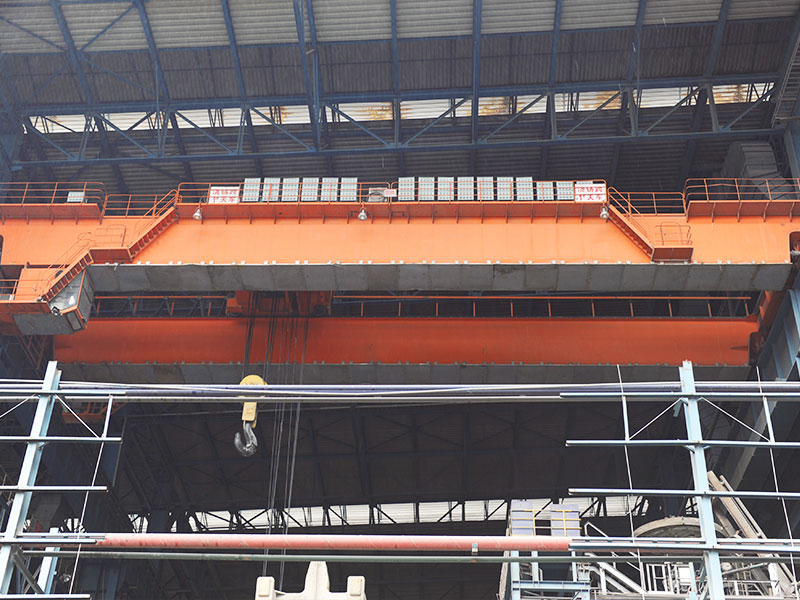
Why Standard Cranes Fail in Smelting Environments
Most industrial overhead cranes are designed for warehouses, machine shops, or general manufacturing—environments where ambient temperatures rarely fluctuate significantly. When you move these standard machines into a smelting or casting bay, the failure cycle is predictable and costly.
- Electronic Component Failure: Variable Frequency Drives (VFDs), contactors, and logic processors are highly sensitive to heat. Standard enclosures allow internal temperatures to climb rapidly, causing capacitor degradation, premature circuit board failure, and annoying nuisance trips that stop production.
- Lubrication Breakdown: High ambient temperatures thin out gear oils and greases. When the oil loses its viscosity, it fails to provide a protective film between gear teeth and bearing surfaces, leading to accelerated wear and eventual mechanical seizure.
- Structural Thermal Expansion: In a furnace environment, steel structures expand. If a crane is not designed with adequate thermal clearance and stress-relief joints, this expansion causes the crane to bind against its own runways, leading to severe tracking issues and wheel wear.
- Insulation Degradation: Standard PVC cable jacketing becomes brittle and cracks when exposed to high heat or molten metal spatter. Once the insulation is compromised, short circuits are inevitable, creating a massive fire risk in areas where molten metal is being handled.
Critical Design Element 1: Heat Shielding and Thermal Isolation
The first line of defense for a 50-ton foundry crane is thermal isolation. You cannot simply rely on the cooling systems; you must stop the heat from reaching the critical components in the first place.
The underside of the crane’s main girder must be fitted with heavy-duty heat shields. These should be constructed with multi-layered insulation, featuring a reflective outer skin to bounce heat away and internal high-temperature mineral wool or ceramic fiber insulation to prevent heat transfer. Furthermore, the trolley-mounted electrical control cabinets must be housed in double-walled, insulated enclosures. These enclosures should be equipped with industrial-grade HVAC units. The goal of this cooling system is not just comfort; it is to maintain a constant, controlled internal temperature—typically below 40°C—to ensure the electronics operate within their design specifications.
Critical Design Element 2: High-Temp Cabling and Electrical Systems
In a smelting bay, standard wiring is a liability. You need to specify high-temperature cabling, typically jacketed in silicone rubber or braided fiberglass. These materials remain flexible and functional even when exposed to high ambient heat or the occasional stray molten spark.
From a design philosophy perspective, try to move the “brains” of the crane away from the heat source. If your plant layout allows, utilize a distributed control architecture. Keep the primary VFD panels and PLC controllers in a pressurized, climate-controlled room on the shop floor, communicating with the crane via robust wireless links or shielded festoon systems. This drastically reduces the number of sensitive components that are exposed to the harshest parts of the crane’s travel path.
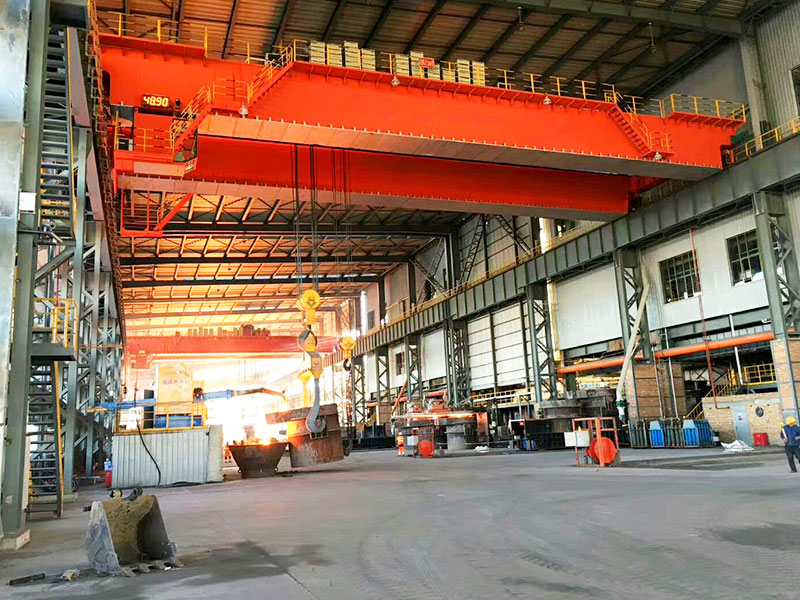
Critical Design Element 3: Bearing and Lubrication Resilience
A 50-ton load places massive radial and axial forces on bearings. When you add high ambient temperatures to this load, you are testing the absolute limits of mechanical physics.
The gearbox design must incorporate oil level monitoring and real-time temperature sensors. The crane’s control system should be programmed to trigger a mandatory warning or shutdown if the gearbox temperature breaches your safety threshold. Regarding lubrication, ensure your vendor specifies high-performance, heat-stable synthetic greases. Additionally, use labyrinth-style seals on all bearing housings. These seals are superior to standard rubber lip seals because they provide a non-contact, tortuous path that prevents conductive smelting dust and metal oxides from entering the bearing cavity. If this dust gets inside, it acts like a grinding paste, destroying the bearings from the inside out in a matter of weeks.
Critical Design Element 4: Structural Redundancy and Duty Cycle
Foundry cranes are often single-point-of-failure devices. If the crane stops, the casting line stops. You should specify a machine with mechanical redundancy that exceeds standard FEM or CMAA requirements.
- Dual Braking Systems: In hoisting operations, include both a primary service brake and a secondary emergency brake on the hoist drum. If a mechanical failure occurs in the primary drive train, the secondary brake ensures the 50-ton load of molten metal stays suspended. A “drop” here is not an option.
- Motor Oversizing: Standard practice is to size the hoist motor based on the load and duty cycle at room temperature. In a foundry, you must de-rate these motors to account for the lack of efficient cooling. If your calculation suggests a 30kW motor is sufficient, spec a 45kW motor. The extra overhead ensures the motor runs cooler and has the thermal capacity to handle the extra load without stalling.
- Smooth Acceleration: Utilize sophisticated VFDs to ensure absolute smoothness. Abrupt starts or stops cause load swinging and structural shock. By programming smooth S-curves for acceleration and deceleration, you reduce the mechanical stress on the entire bridge, extending the life of the wheel trucks and girder welds.
Critical Design Element 5: Maintenance Accessibility
In a high-heat environment, nobody wants to spend more time than necessary on the 50 ton overhead crane. Your design should prioritize “maintenance-from-a-distance.”
- Integrated Walkways: Ensure the bridge is equipped with wide, anti-slip grated walkways. Maintenance personnel should be able to walk the entire span of the crane safely without having to navigate precarious, narrow ledges.
- Centralized Lubrication: Spec an automatic, centralized lubrication system that routes all grease points to a single, easily accessible manifold, preferably located near the bridge walkway or a service platform. This prevents technicians from having to climb into hazardous “hot zones” just to perform routine grease jobs.
- Predictive Diagnostics: The crane should come with a dashboard that displays real-time data: motor temperatures, VFD load percentages, brake pad wear, and vibration levels. This shifts your maintenance strategy from “reactive” (fixing it when it breaks) to “predictive” (addressing issues during planned downtime).
Conclusion: The Business Case for the Right Crane
Buying a 50-ton foundry crane is a significant capital investment, and the specialized versions will certainly cost more upfront than a standard model. However, look at the Total Cost of Ownership (TCO). A standard crane in a smelting bay will suffer from constant downtime, excessive parts consumption, and a shortened operational lifespan. By investing in thermal shielding, high-temp components, and structural redundancy, you gain reliability. The costs of just two unplanned production stoppages on a casting line often exceed the entire price premium you paid for a custom-engineered crane.
When vetting overhead crane manufacturers, don’t just look at the quote—look at their engineering documentation. Ask for their heat-load calculation reports and their specific material certifications for the electrical components. A manufacturer that provides this level of detail is one that understands your environment and is prepared to build a crane that will last for decades, not just a few seasons.